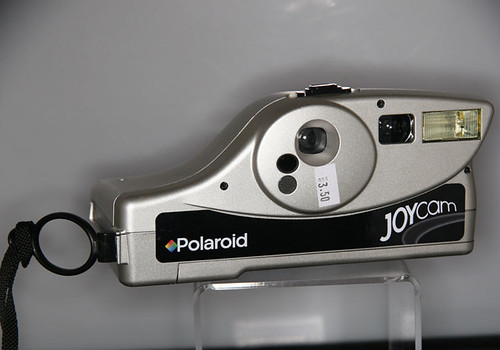
The Captiva and Joy use the no-longer-manufactured Polaroid 500 Instant film.
Polaroid Type 500 film (produced from 1993-2005) has an image size of 73x54mm ( 2.874 x 2.126 inches), is ISO 600 and has 10 pictures to a pack.
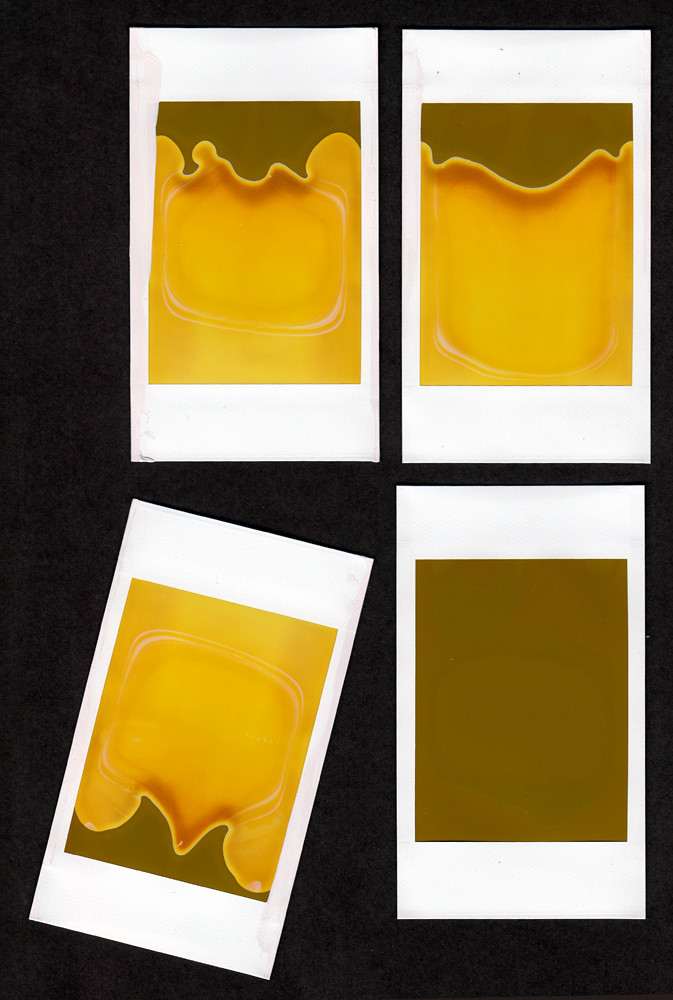
My initial experience is that most existing packs available today have been improperly stored, causing the internal chemicals to dry out. The result causes film packs to leak caustic chemicals upon firing the shutter, malfunction or failure to eject any image at all.
One of the packs exposed through the Captiva camera yielded some decent images (above).
Existing, expired film packs are scarce. When available these film packs can fetch upwards of $20. - $50. each on ebay.
Further testing and experimentation as soon as I can locate more film packs.
A fellow FLICKR member sent me FlickrMail today regarding the new Polaroid 300 camera. Below is his correspondance and my response.
Hi Michael
How do you like your 300? I've been a Polaroid fan for a while and normally use an SX-70. After seeing your shots with the new 300, I decided to get one of my own. How's your experience been when shooting in bright sun? I've wasted over a pack just testing out the fine vs clear settings, most are coming out very over exposed (and the sun is at my back). Any tips?
Thanks! Bob
*****************************
Hi Bob,
Polaroid 300 in direct sun is a bit tricky. Many times I forget to switch the filter to sun!
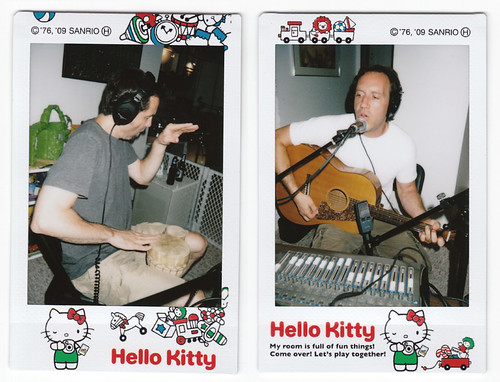
Here's a few shots that are a little overexposed but still pleasing:
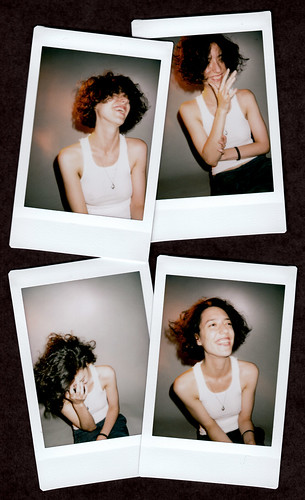
My favorite shots with the 300 camera are studio shots where I mix the on-camera flash with a strong backlight.
Studio shots of comedian Méla Eloise Nichols with the Polaroid 300 camera
All in all, I really love the camera.
I also picked up a used Polaroid Mio on e-bay. They use the same film.
Although I tend to use the Polaroid 300 film (Purchased on-line at J&R Electronics), you can also use the Fujifilm Intax Mini film.
There is no getting around that the Polaroid 300 is a consumer camera with the minimum of features. More than half the fun is using the camera in situations that it wasn't designed for. I've never had an issue with shots turning out unusable. Best of luck with your new 300.
“Summer Vacation” features the live music of the Pink Delicates. Photo chat includes the Olympus Trip 35, Polaroid Mio, listener letters and much more.
What Has Made The Guys Better Photographers? Watching Stanley Kubrick Films. Looking at other Artist's work. Criticism at College classes. Practice, shooting lots of Film. Having fun!
Only 4 months left to shoot Kodachrome and send it out for developing at Dwaynes Photo!
Street photography. An entire genre dedicated to photographs taken on the street. How did it come about, what is it all about, and perhaps most importantly, how do I get in on it?
Characteristics
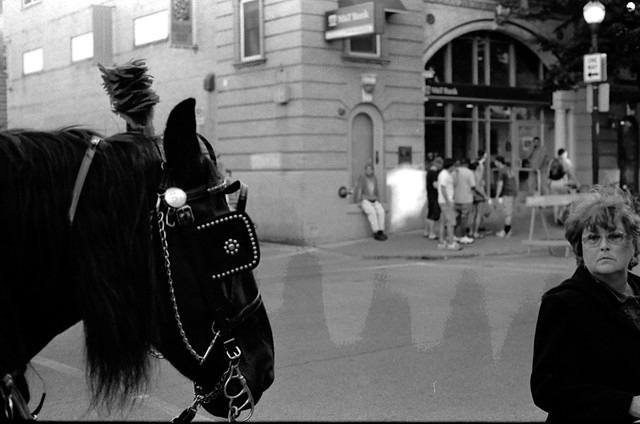
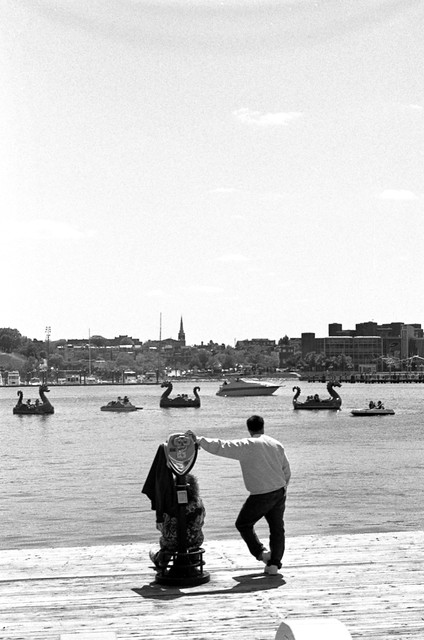
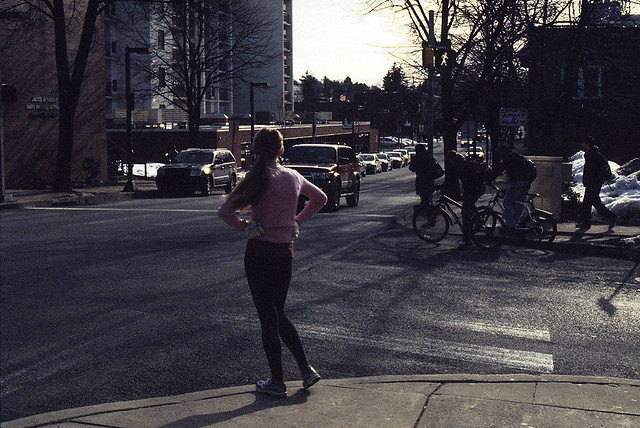
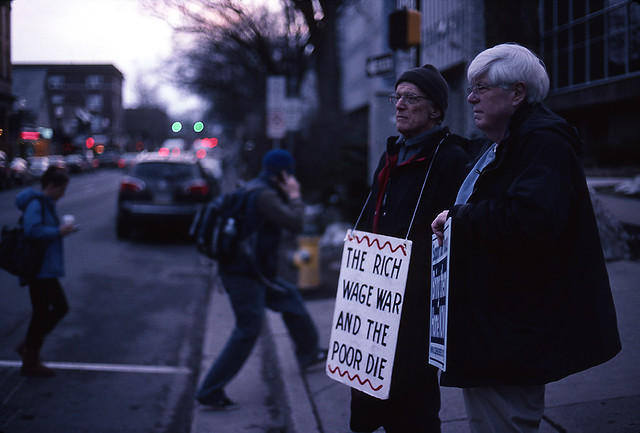
Rather than try to define the genre specifically, I think it's best to define by example characteristics. For instance, it's not photos of bridges and road signs. A form of photojournalism, street photographs are taken out in public - usually, as the name implies, on the street - and usually having other human beings as the subject. They are not portraits, but rather candid shots - often, the subject will not be aware of being photographed, or will realize it only after the fact. A majority of photos are a bit grainy, taken on medium-speed (400 ISO) black-and-white 35mm film, with a standard or wide-angle focal length. The camera often captures a very specific moment on the film, and the end effect conveys some emotion or theme, such as irony. In all, the genre is about photographs that are a "slice of life."
The Masters
Photography started out large. Press cameras, like the more modern Speed Graphic, took 4x5 sheet film. While they were arguably portable, were hardly inconspicuous. As 120 roll film became popular, so did smaller cameras such as the classic twin lens reflex architecture. But it wasn't until 35mm film came out that you could take a photo without getting noticed.
[Henri Cartier-Bresson, Behind the Gare St. Lazare, Paris. Image from Wikipedia]
Most people would agree that the great-grandfather of the genre, the all-knowing master, was a French man named Henri Cartier-Bresson (pronounced on-Ree Car-tee-AY breh-SAWN) (b.1908 - d.2004). Cartier-Bresson pretty much founded the idea of trying to capture a "decisive moment" on film. Furthermore, he knew that to observe the moment, you must not interfere. His camera always acted as an imaginary window to a particular point in space and time and was rarely acknowledged, possibly assisted by the fact that the shiny chrome parts of his camera were painted black.
If Cartier-Bresson was Socrates, then the role of his student Plato was played by Garry Winogrand. Well, he wasn't actually a student, but he was a natural successor. People shoot photographs for a variety of reasons, but Winogrand did it because that was the only way he could live. He died leaving behind nearly 300,000 unedited images, and more than 2,500 undeveloped rolls of film. His published photos documented the mid-20th Century, particularly the 60's and 70's, and they typically exhibit some sort of wit or irony.
Watch Winogrand at work here (sorry, but it's overdubbed):
Nowadays, color film and digital have sort of taken the edge off street photography, and you'd struggle to mention modern masters of the genre. Yet, there are certain people I admire, such as Gary Gumanow (Flickr) and some of the work of Chris Weeks (who has a number of sites, but I prefer his Flickr site.
The Equipment
First off, you should know that every name I've mentioned so far has used one brand of camera - Leica. Cartier-Bresson used a Leica III and an M3. Winogrand used an M4. Gumanow uses an M6-TTL, among other cameras, and Weeks uses an MP (also a digital M9, but we won't go there...) The Leica camera, a bayonet-lens-mount "rangefinder" camera, was introduced in 1930, and underwent a few iterations before the Leica M3 - arguably the quinessential Leica - came out in 1954. They were used heavily in combat photography, because they are durable and reliable. I've had the pleasure of handling a Leica M3 - though it is small, it's built like a tank.
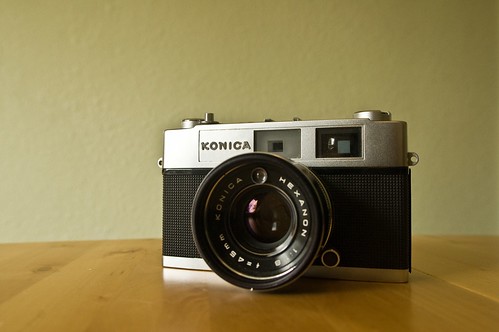
The Konica Auto S2. Photo by Flickr user sparkrobot
Now if you're like me, then a Leica has too much of a rabid cult following to be affordable anymore. However, there are solutions if you want to go about getting into street photography more cheaply! What you must shop for is a combination of speedy operation and inconspicuousness. The answer lies in the architecture of the 35mm rangefinder. First, the rangefinder is quick to focus, because you line up two identical images in the viewfinder to focus on a particular object. It is generally a bit quicker than dealing with a split-image prism or other manual-focus SLR focusing screen. As far as stealth is concerned, the rangefinder does not have a rising mirror as can be found in SLR cameras - in which you compose through the lens - so there is no mirror snap sound produced when you take a picture. The shutter just fires, and that's it. Leicas are renowned for their quiet focal plane shutters, but leaf shutters are also especially quiet. Therefore, I would recommend any 35mm rangefinder with a 50mm lens, preferably with a leaf shutter. I now use a Konica Auto S2, which has all these features, except that the lens focal length is actually 45mm. Don't worry about whether the lens is removable. You'll want something close to 50mm about 95% of the time. If not, then something wider will suffice to get up close and personal. You might want to carry around a Superheadz Ultra Wide and Slim knockoff for backup.
If you're using 35mm film, your best bet would be to load up on a 400-speed film such as Kodak Tri-X or my personal favorite, Ilford HP5+. They've got the perfect amount of grain to give you that "edgy" photojournalism look, without being too distracting. For developers, I'd recommend either Kodak HC-110 or Agfa Rodinal, but that's really more of a personal preference once you find one you like. If you're printing the old-fashioned way, try printing the full frame of the negative with some black border, the way Cartier-Bresson did.
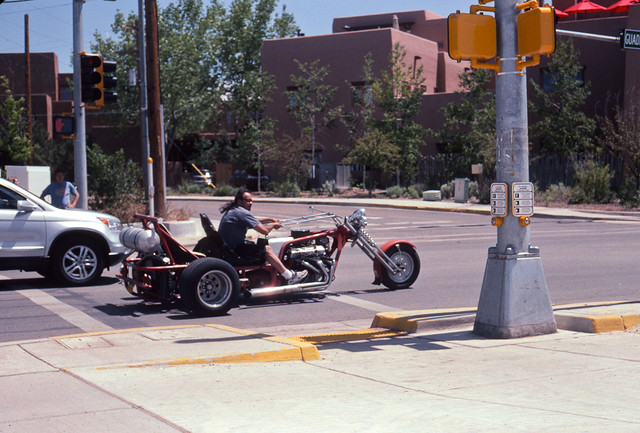
Of course, who's to say you can't shoot color, or even a roll of Kodachrome before the end of the year? A few of my shots below feature Kodachrome. Street photography is what you make it and is more about the craft than the tools you use.
The Craft
Before you even attempt your first street shot, I can tell you that your biggest problem you're not close enough. Most of my street shots are taken from too far away. You need to get right up in the faces of your subjects, which may or may not be so easy depending on where you are. I'd imagine the attitudes of passersby in India are much different than those in Manhattan.
One thing that may help your sneakiness is taking the photograph without looking through the viewfinder - a true "point and shoot" technique. Simply set the camera's focus to what you think is right, aim to where you think the subject will be in frame, and shoot it. It's not like you've got anything to lose, especially if you're shooting black and white, which is relatively inexpensive. The downside is that the closer you are, the less latitude you have with respect to your focus setting. Wider apertures help.
(Note: I'm not a lawyer, so don't hold me responsible for the legality of this next paragraph...)
Generally speaking, you're perfectly within your rights to photograph people in public, because people in public have no expectation of privacy. The legal question becomes more muddy once you try using your photos commercially, though, since you need permission to use someone's likeness for financial gain. So while you're practicing your art, you can shoot away in public places and no one can really do anything about it - but it's also common sense to try to be as personable as possible if and when you get "caught." Remember, it's not like they're Michael Phelps, and it's not like they're smoking pot.
Shameless Self-Promotion
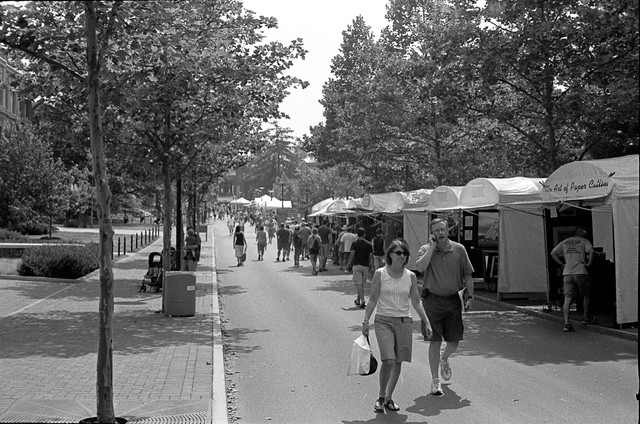
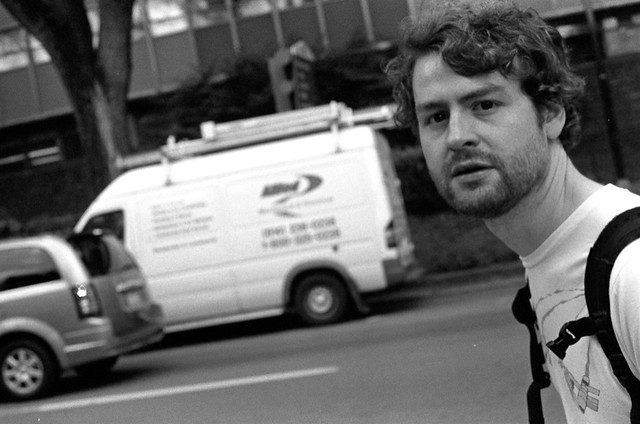
I've got a long way to go, but I thought I'd close with a handful of shots that I've taken, which you can find on my Flickr page.
Dan Domme is a film photography enthusiast and PhD student in the Acoustics department of Penn State. He's been a serious photographer for the last two years, and now shoots nearly exclusively on film. (He even owns a sweet Hasselblad.) You can view his Flickr stream at http://www.flickr.com/photos/yeknom02/ or his photography blog at http://dommephoto.wordpress.com/
You’re not going to believe this but not too long ago there was no such thing as the Internet. Yes, that’s right…no on-line. No cell phones , either.
C’mon, think hard. Remember?
Okay, okay…then THIS is something you won’t believe. On Route 46 in New Jersey there is an actual store that sells camera stuff. Get this…. they sell film too. (Sigh) You do remember film, right? Okay, put your iPhone down and listen up. Or better yet, open up the Wiki on yer iPhone and look up film.
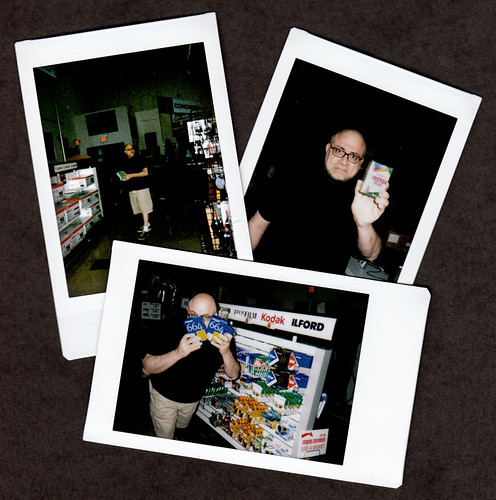
Okay, this is going to blow your mind (insert sound effect here). To get my hands on film, it is actually faster for me to drive-to-the-store than to order on-line. The store is Unique Photo in Fairfield, NJ. A short drive from the Film Photography Podcast Studio, this cavernous store (with coffee bar) is most likely the last brick and mortar store to offer Polaroid integral and pack film products.
(clockwise from upper left) A surrealistic experience finding film displayed in an isle of an actual store…it’s true – Polaroid 300 film is nothing more than re-branded Fujifilm Instax…600, Spectra and Pack film galore (but watch out for the “price sting” on the 600 film)
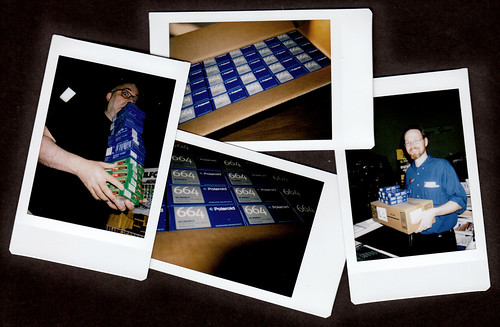
I stocked up on pack film including 2009-dated Polaroid 664, 667 and fresh-dated Fujifilm FP-100c. Thanks, Paul!
I found a bit of Unique history on the web: “In 1947 Bernard Sweetwood and his wife Harriet founded Unique Photo. Forged by their hard work and fueled by Bernard's lifelong passion for photography, the small Brookyln storefront quickly blossomed into today's Unique: one of the largest and most successful suppliers of its kind. In 1965, the company moved across the Hudson. In 2008 the company - now headed by sons Jonathan and Matthew - moved to its current state of the art facility in Fairfield, New Jersey.”
I even located this “cable spot” on You Tube!
When visiting the Garden State, enjoy a real store experience at Unique…and don’t forget to shoot me an e-mail…I’ll meet you there for some Java! - Michael Raso / FilmPhotographyPodcast@gmail.com
With the re-emerging Instant Films in stores this year via Polaroid / Fujifilm and The Impossible Project, amateur and professional photographers alike have raised their eyebrows after initially thinking that instant photography was going the way of the dinosaur when the end of instant film was announced by Polaroid in 2009.
ABC-TV New York report on the end of Polaroid instant film
In 2010, instant photography is alive and well with continued commitment by Fujifilm in Japan and grassroots movements like http://www.savepolaroid.com/ and The Impossible Project getting more attention this year than in the last two decades combined.
The Fujifilm commitment aside, most instant film excitement has been coming from an old Polaroid factory in Enschede (pronounced En-Ska-Day), Netherlands, where The Impossible Project purchased equipment from Polaroid and promised to make new films for the millions of existing Polaroid SX-70 and 600 cameras in the world.
CBS-TV USA report on the end of Polaroid and beginning of The Impossible Project
For those of you who don’t eat, sleep and breath Polaroid photography (like me!), instant film by definition “is a type of photographic film first introduced by Polaroid that is designed to be used in an instant camera (and, with accessory hardware, with many professional film cameras). The film contains the chemicals needed for developing and fixing the photo, and the instant camera exposes and initiates the developing process after a photograph has been taken.
1963 Polaroid instant camera TV ad
In earlier Polaroid instant cameras the film is pulled through rollers which breaks open a pod containing a reagent that is spread between the exposed negative and receiving positive sheet. This film sandwich develops for a predetermined time, depending on film type and ambient temperature, after which the positive sheet is peeled away from the negative to reveal the developed photo.
In 1972, Polaroid introduced integral film, which incorporated timing and receiving layers to automatically develop and fix the photo without any intervention from the photographer.”*
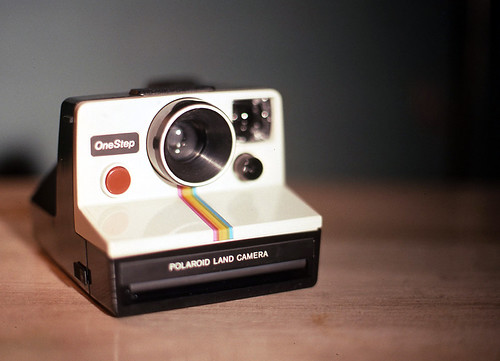
Most folks are familiar with integral instant film with cameras like the Polaroid One-Step. Polaroid cameras were heavily, heavily advertised in the 1960s through the 1980s.
Polaroid One Step TV Ad 1981
The Impossible Project has made good on their promise and in March 2010, introduced monochrome SX-70 and 600 films. On July 29th, Impossible introduced their “First Flush” edition of color film for SX-70 cameras and plan on releasing color film for 600 cameras later this year.
Earlier in 2010 Polaroid Corporation announced a new, re-envisioned One-Step camera called the One Step pic-1000 to be available in December 2010.
The Polaroid Pic-1000 announced January 2010 at the CES show in Las Vegas, Nevada USA
Then, two months later under the direction of Lady Ga Ga (Polaroid’s new Creative Director), Polaroid surprisingly released the Polaroid 300 camera.
Lady GaGa discusses her creative partnership with Polaroid
The camera uses business card sized color film and was released to the US market in April 2010. Many on-line bloggers have noted that the release of the 300 camera solidifies the Polaroid-Fuji relationship since the 300 camera and film is manufactured by Fujifilm Japan re-branded Polaroid here in the United States.
Elsewhere in the world, the camera is known as the Fuji Instax Mini. It should be noted that Fujifilm attempted to release their Instax Mini cameras and film here in the US in 1999 but instead made an arrangement with Polaroid and partnered on the short-lived Polaroid Mio camera.
It is suggested that Polaroid will continue the relationship with Fujifilm and introduce the Pic-1000 camera with new 600 film manufactured by Fuji late in 2010.
The “Just Do It” episode. Topics cover big format film, publishing your photo, CLA: clean-lubricate-adjust, Polaroid updates and more! Hosted by Michael Raso and Duane Polcou
Donate to the Film Photography Podcast Do you have a (working) camera you’d like to donate? Extra film? (expired is okay)…we’ll give away your donation to an FPP listener! Have extra cash…donate and we’ll invest in additional cameras and gear to give away. If you donate over $100 cash, you'll get one of Michaels prized Film Cameras.
Letters to FPP Send us an e-mail (FilmPhotographyPodcast@gmail.com) or an old-fashioned hand-written letter! Film Photography Podcast c/o Pop Cinema PO Box 152 Butler, NJ 07405 USA
Duane and Michael have a discussion about how you can improve your chances of getting paid work by expanding your portfolio with "free" images and tear-sheets (which are your photos torn out of published magazines). If your work is out there and promoting your name (even if you're not getting paid), surely you're improving your visibility to paying customers.
We're giving away a Polaroid 600 camera (with Impossible Film) in the next episode, so please send an email with "Polaroid 600" in the header, and a short explanation of who you are, what you do, your address, and why you shoot film.
email address: filmphotographypodcast@gmail.com
We're also giving away the camera that Dan Domme donated, the Agfa Clack, if you'd like to be in the running to pick up this 120 film camera, again, email us with "Agfa Clack" in the header, and a short explanation of who you are, what you do, your address, and why you shoot film.
Want to enter both contests? PLEASE SEND SEPARATE EMAILS!
Remember that there's not long to shoot and develop your Kodachrome and get it sent off to Dwayne’s Photo. Get Kodachrome on eBay! You've only got until December 30, 2010.
In a future episode we'll be talking about work flow (shooting, processing, scanning, digital management, archiving)
Michael and Duane discuss taking stills during a film production.